
Wednesday Grammar Lesson

Active vs. Passive Voice

Asking “What’s going on?” is very likely to find you the verb in any given sentence. If this question works, you’re dealing with an active verb. Sentences written in active voice mean that the subject of the sentence is doing the action.

Compare the following:

1) Milton and Shakespeare drove to the bookstore.

2) Milton and Shakespeare were driven to the bookstore.

In sentence 1, Milton and Shakespeare are doing something. When you ask the question, “What’s happening?”, you find that driving is happening. But in sentence 2, the answer to the question “What’s happening?” is different. Milton and Shakespeare aren’t driving anymore—they’re being driven. In sentence 2, someone else not specified in the sentence is in the driver’s seat.

Sentence 2 contains a passive verb. In passive sentences, the subject (above, Milton and Shakespeare) doesn’t actually do anything; rather, action happens to the subject. The subject is not creating action but receiving it. It’s a subtle but important difference.

You might notice something else different about the verb in sentence 2. It has a helper, the word were. Passive voice verbs usually use some form of the word to be: am, is, are, was, were, be, being, been. The versatile word to be doesn’t always indicate passive voice, but it’s a pretty good guideline.

So if you ask, “What’s going on?” in the sentence, take note about exactly where the action is happening. Sometimes the subject is doing the action (that’s active), and sometimes the subject is receiving the action (that’s passive).

Note: English teachers get a bad rap for hating passive, but active voice is usually easier to read and understand than passive voice. You should only use passive voice when there’s no way to express your ideas using active voice. That means that you should use active voice almost all the time.
Tuesday Book Talk

Stuff I’ve Been Reading: June 2012

This June was a stupendously prolific month for two reasons: traveling and unfinished books.

  1. The Faerie King by C. A. Cole. While in Scotland, I reread and annotated a hard copy of my friend’s excellent first novel in the Pooka series.
  2. An Equal Music by Vikram Seth. This fat novel about musicians kept me occupied for the longest of the three legs of my return flight.
  3. The Wasp Factory by Iain Banks (40%). While I adore Iain M. Banks books (SF), I did not much care for this first of the Iain Banks books (mainstream fiction).
  4. Shades of Milk and Honey by Mary Robinette Kowal. Home again, I reread the first of the Regency “glamour” novels in preparation for the just-published book two.
  5. Glamour in Glass by Mary Robinette Kowal. Book two and a continuation of the above, lots of fun.
  6. Swamplandia! by Karen Russell (30%). Despite having won a lot of nominations and awards, and despite my having liked her short story collection St. Lucy’s Home for Girls Raised by Wolves, I disliked this novel about a family (and gator theme park) falling apart.
  7. Unnatural Death by Dorothy L. Sayers. In To Say Nothing of the Dog by Connie Willis, a character is crazy about Sayers mysteries. This is the third one featuring Lord Peter, though the ones with Harriet Vane in them are said to be better.
  8. Strong Poison by Dorothy L. Sayers. Book five of above, and the first novel featuring Harriet Vane. A bit better, but not as good as Agatha Christie.
  9. The Shadowed Sun by N. K. Jemisin. The just-published sequel to Jemisin’s first Dreamblood book, The Killing Moon. I liked both of them quite a lot.
  10. The Violent Bear It Away by Flannery O’Connor (60%). Now I know why O’Connor is known for her short stories rather than her novels: this is her second and last novel, about a crazed prophet and his great-nephew.
  11. Quicksilver by Neal Stephenson. An unusual historical novel by a SFF author set in the Baroque period, about scientists–or, rather, natural philosophers.
  12. The Prague Cemetery by Umberto Eco (20%). For this and the following few, see last week’s book talk.
  13. The Case of the Missing Servant by Tarquin Hall. See last week’s book review.
  14. Prospero Lost by L. Jagi Lamplighter (20%).
  15. The Demi-Monde: Winter by Rod Rees. Loved it: will read all four.
  16. Night Flight by Antoine de Saint-Exupéry.
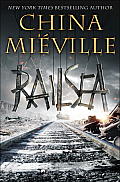
  17. Railsea by China Miéville. See yesterday’s book review.

This month’s books by number: 5 unfinished, 5 fantasy, 3 mystery, 2 literary, 2 science fiction.

Best new read? A tie between Railsea and The Demi-Monde, with Glamour in Glass a close second.

Monday Book Review

Hello, and welcome back to the Monday Book Review.

Today I’ll be reviewing China Miéville’s newest young adult novel, Railsea.

First sentence: This is the story of a bloodstained boy.

In a world where the earth is covered with endlessly criss-crossing railroad tracks and huge moles and other predatory beasts lurk underground, the newly christened doctor’s apprentice Sham, aboard the moletrain Medes, has found a treasure.

In a derelict traincar, amidst corpses and mole rats, Sham uncovered it: a memory card with photos of the train’s final, fatal, unbelievable find. Sham himself doesn’t understand how significant his discovery is, but he learns quickly that a lot of people are interested.

Rumor-sellers. The Shroake siblings. Pirates. Wreckers. The ferronavy. Even the Medes gets involved for the hunt for the End of the Line.

If you like action, adventure, and intrigue in an unbelievably well-imagined setting, Miéville’s reinvention of Melville’s Moby Dick will surpass your expectations.

Design a site like this with WordPress.com
Get started