
Thursday Life Rant

I am not a teacher anymore. I am a full-time legal receptionist in a boutique law firm.

(Those of you who know me well know how pleased this makes me.)

Since the beginning of June, I’ve been taking an Intro to Paralegal course to investigate whether being a paralegal would be better than being a freshman composition teacher. Turns out it would.

Knowing how difficult it is to find a job, and desperate not to return to either of my two part-time teaching positions, I began haunting the Craigslist legal/paralegal section. A week from last Friday, I saw a listing that looked likely and sent in my resume.

On Monday, they called me. On Tuesday, I had my first interview in a Starbucks. On Wednesday, they called me back. On Thursday, I had my second interview in their law office.

And then came the long, terrible weekend in which I agonized over everything I’d said and how I’d said it. The phone never left my side. Ring, damn you, ring!

Turns out it did. Yesterday, Wednesday, they called me with the job offer. My first day of work is Thursday, July 5.

I’m not a teacher anymore! I’m going in to the legal field.
Wednesday Grammar Lesson

The difference between grammar and usage is important to recognize. If you have a grammar mistake, you’ve written something that breaks the rules that govern the relationship between words in English. It’s a problem that ought to be fixed.

But if you have a usage issue, you’ve written something that isn’t grammatically in correct per se, but isn’t as efficiently communicated as it could be.

One of the most common usage issues is dead, redundant, or otherwise meaningless words, the worst offending examples of which are “there is/was” and “there are/were.”

In formal written English (or in any English that strives to engage and retain readers), starting your sentence with “there is” is about the worst plan around. Not only does “there is” merely tell you that something exists, but it’s also pretty vague about what is existing. You’re making your reader wait until at least the third word of the sentence to figure out what you’re talking about.

When you write,

There was a woman who checked out too many library books.

nothing has actually happened in the sentence. A woman exists. A woman exists “there.” Yawn.

Why not start the sentence with the woman? And instead of mentioning her existence, why not say what she’s doing? In all kinds of writing, “there is” can easily be trimmed away to improve the sentence.

Instead, write this:

A woman checked out too many library books.

Brilliant! A masterpiece of efficiency and concision! By removing the dull “there was,” you’ve made this sentence both active and shorter–traits to be desired in good usage.

Tuesday Book Talk

I’ve discovered the library.

It’s not an original find by any means, but after a year of living in my current city, I’ve finally renewed my library card. I spent my first trip getting the lay of the land, so to speak, and gave the SFF section a close examination, coming away not altogether displeased.

Since my last library trip, I’ve also perused the library collection online, crossing my Powell’s wishlist with the library catalog. It turns out that the library has quite a lot of books I’ve been wanting to read for a while.

Here’s what I got on my first trip:

  • The Prague Cemetery by Umberto Eco. I read fifty pages and stopped: there is no Eco novel quite like The Name of the Rose.
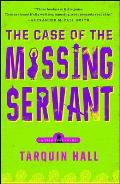
  • The Case of the Missing Servant by Tarquin Hall. See Monday Book Review.
  • The Case of the Man Who Died Laughing by Tarquin Hall. The sequel, which I decided not to read.
  • Prospero Lost by L. Jagi Lamplighter. I read fifty pages and stopped: this urban fantasy with Shakespeare’s The Tempest characters was fun but wasn’t working for me.
  • The Demi-Monde: Winter by Rod Rees. I’m currently reading this one and liking it a lot. The Demi-Monde is (I think) a virtual-reality-gone-real. I’m tempted to call the novel an “urban alternate-future dystopia,” but the premise quite rightly defies description.

And on hold for me, among other books on the shelf, is Night Flight by Antoine de Saint-Exupery, a French pilot best known for The Little Prince but whose memoir of flying for the post, Wind, Sand, and Stars, I quite loved.

Anyway, yes, the library: a bookstore where all the books are free.

Monday Book Review

Hello, and welcome to the Monday Book Review.

Today I’ll be reviewing The Case of the Missing Servant by Tarquin Hall.

First sentence: Vish Puri, founder and managing director of Most Private Investigators Ltd., sat alone in a room in a guesthouse in Defense Colony, south Delhi, devouring a dozen green chilli pakoras from a greasy takeaway box.

What attracted me to this book was, in fact, its colorful cover design. It’s a mystery set in Delhi, starring the rather overweight but quite canny Vish Puri, private investigator of considerable repute. Written by a journalist, this book is full not only of cultural and geopolitical facts about Delhi but also of local color designed to expose some of the class inequality that Vish Puri (and, very blatantly, the author) laments.

What I liked most about this book was not, in fact, the mysteries, though they were fun and intriguing enough, but the actions that Vish Puri took to solve them. These included traveling, dressing up in disguise, bribery, deception, stake-outs, bugging people’s houses, and networking with many personal and professional connections. There was also plenty of takeaway-eating. Puri has an affinity for very spicy food and grows custom chillis on his roof.

While I enjoyed this book quite a bit, I probably won’t read its sequels, one in print and another forthcoming. I felt too much that I was the audience, a foreigner to Delhi who was supposed to be surprised and at times shocked by the city’s crime and cultural mores. It was, in short, a book with an agenda that rubbed me ever so slightly the wrong way. Class inequality, yes, I see.

I will continue my perpetual hunt for a mystery whose setting and detective play a large role in the solution of the case (as in The Case of the Missing Servant) but whose author allows the themes of the book to speak for themselves.

Design a site like this with WordPress.com
Get started